Best Essential Oils to Mix With Castor Oil and How Much
Castor oil has almost no scent of its own, which makes it a blank canvas, and a slow, glossy one: it stays where you put it, and so does anything you stir into it. That is the whole idea behind this roundup. We think five essential oils are worth knowing, and our advice about every one of them is the same: use less than you expect.
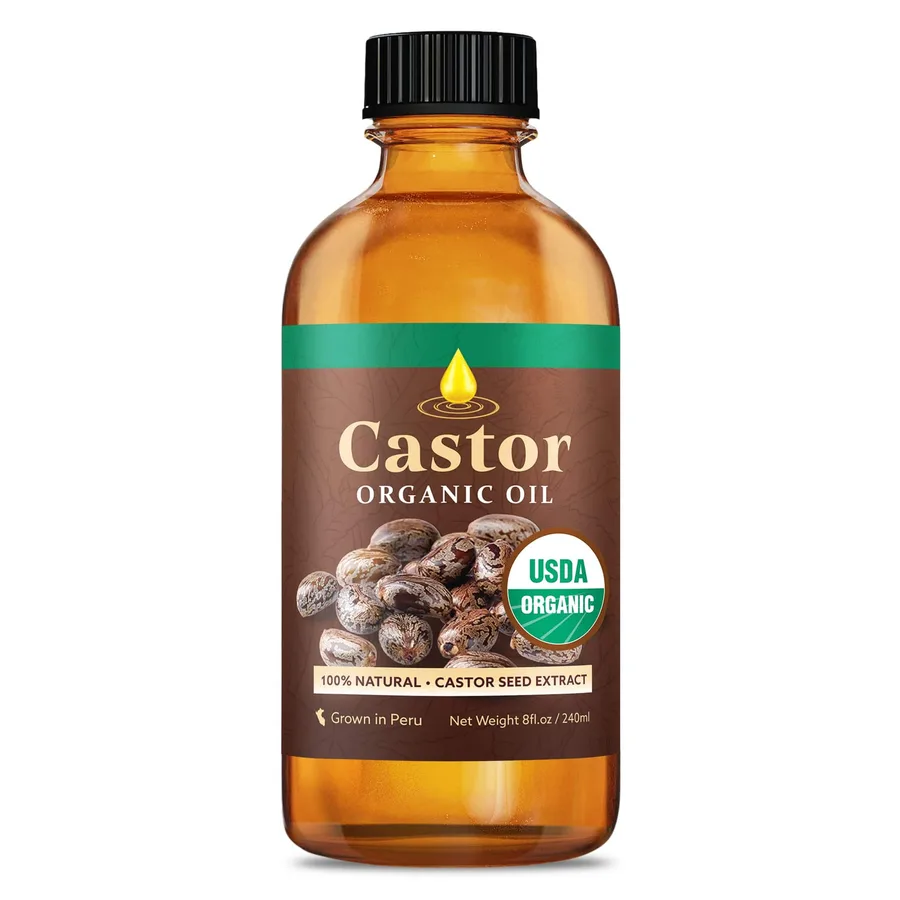
Organic Castor Oil
Cold-pressed, hexane-free castor oil, in sizes from a 0.5 oz sample to bulk drums.
From $13.99
Shop Organic Castor Oil →There is a quiet pleasure in blending your own scent, and it starts with how thick castor oil feels when you stir. It folds the fragrance in slowly, like honey taking a spoonful of spice, and what you get is soft and rounded rather than sharp.
One rule for all five
Here is the logic we use in every blend. Castor oil is roughly a thousand times as viscous as water (a published review puts it at 9.3 to 10 poise at 25 C), so it lingers on skin and hair rather than sinking in. That suggests the scent lingers too, and a little goes a long way.
The Tisserand Institute's Dilution for essential oils gives 0.5 to 1.2 percent for the face, 1 to 3 percent for the body and 0.2 to 1 percent for sensitive skin, and says allergy is the most common reaction and dilution cannot undo it. So we start at 0.5 percent, never go above 1 percent, and add one oil at a time, so that if you notice a reaction you know the cause.
The arithmetic, assuming 20 drops to a millilitre (drops vary, so treat it as an estimate):
| Batch size | At 1% | At 0.5% |
|---|---|---|
| 10 ml (a small bottle) | 2 drops | 1 drop |
| 30 ml (1 fl oz) | 6 drops | 3 drops |
| 60 ml (2 fl oz) | 12 drops | 6 drops |
| 120 ml (4 fl oz) | 24 drops | 12 drops |
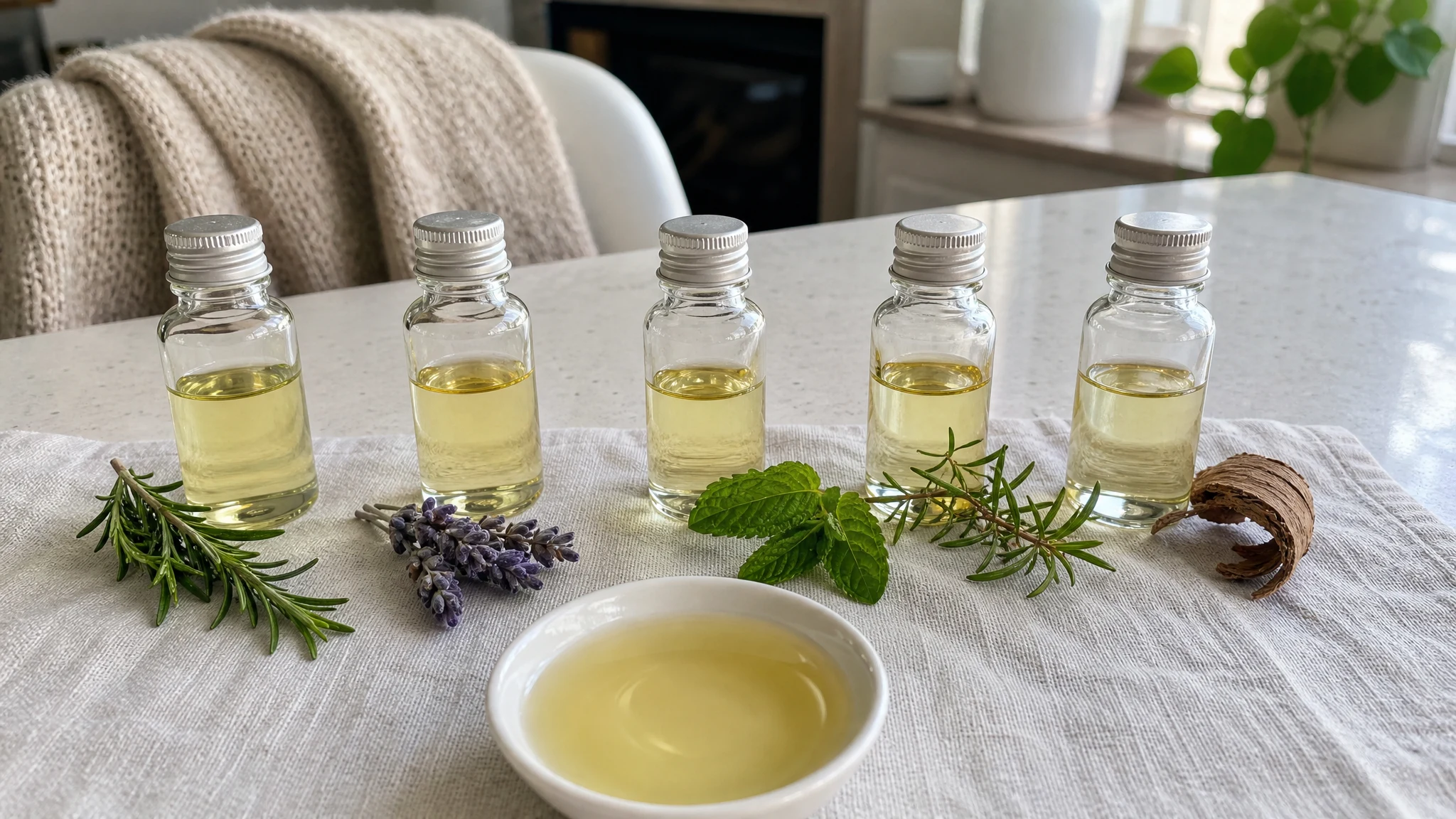
Rosemary
Green, brisk and herbal, with a resinous edge. It is the classic partner for hair blends, and our castor oil and rosemary oil blend post has the full method. For rosemary the Tisserand Institute advises seeking a doctor's advice first if you are pregnant or have epilepsy (Safety Guidelines - Tisserand Institute).
Lavender
Soft, sweet and herbal, the scent of a linen cupboard. A scent that promotes relaxation is a fair description, which is why we pair it with evenings in our lavender and castor oil blend. NCCIH notes that topical lavender products may cause allergic skin reactions in some people (Lavender: Usefulness and Safety), which is one more reason for the patch test.
Peppermint
Cool, sharp and sweet at once; the cool note comes from menthol, a component of peppermint oil. It is the most vivid of the five, so we keep it at the low end and give it its own page: castor oil and peppermint oil. NCCIH says peppermint oil should not be applied to the face of infants or young children (Peppermint Oil: Usefulness and Safety).
Tea tree
Sharp, clean and a little earthy, with a camphor-like freshness. NCCIH says some people get redness or irritation, more likely if the oil is old or has been exposed to heat, light or air (Tea Tree Oil: Usefulness and Safety). Buy a small bottle, keep it cool and dark, and use it within a reasonable time.
Cedarwood
Warm, dry and woody, like fresh pencil shavings. A 2025 review of cedarwood oil cites a limit of 2 percent or less for leave-on products and recommends patch testing (Cedarwood essential oil (Cedrus spp.): a forgotten pharmacological resource with emerging therapeutic potential), so our 1 percent ceiling sits comfortably under it. Cedarwood is a common name for oils from more than one tree, so look for the botanical name on the bottle you buy.
Our recommendation
If you have never blended before, begin with one oil at 0.5 percent in a 30 ml batch, which is just 3 drops. Live with it for a week. Then move up to 1 percent if you want more, or try a second oil in a separate batch. Resist the urge to combine three at once; castor oil carries scent strongly, and a crowded blend turns muddy fast.
When you test a blend, give it a moment on the back of your hand and smell it again after a few minutes. Scents change as they settle, and the one you first liked in the bottle is not always the one you want at the end of the evening. We would rather you trust that second sniff.
We sell castor oil only and no essential oils, so you will find these at a pharmacy, a craft shop or a beauty-supply shop. If a blend turns out too heavy for what you want, diluting castor oil with a lighter oil is the usual fix, and thinning it has more ideas.
Pick the scent that makes you smile when you open the bottle, because that is the one you will actually use.
Organic Castor Oil
Cold-pressed, hexane-free organic castor oil, from a 0.5 oz sample to bulk sizes.
From $13.99
Shop Organic Castor Oil →Sources & Further Reading
- Dilution for essential oils
- Safety Guidelines - Tisserand Institute
- Lavender: Usefulness and Safety
- Peppermint Oil: Usefulness and Safety
- Tea Tree Oil: Usefulness and Safety
- Cedarwood essential oil (Cedrus spp.): a forgotten pharmacological resource with emerging therapeutic potential
- Castor oil (Ricinus communis): a review on the chemical composition and physicochemical properties