Ricinoleic Acid: The Fatty Acid Behind Castor Oil
Most vegetable oils are a crowd: a bit of oleic, a bit of linoleic, a few saturated acids in the background. Castor oil is closer to a solo act. One fatty acid, ricinoleic acid, makes up the large majority of it, and nearly everything you notice about the oil, from the slow pour to the cushioned feel, traces back to one small feature of that molecule.
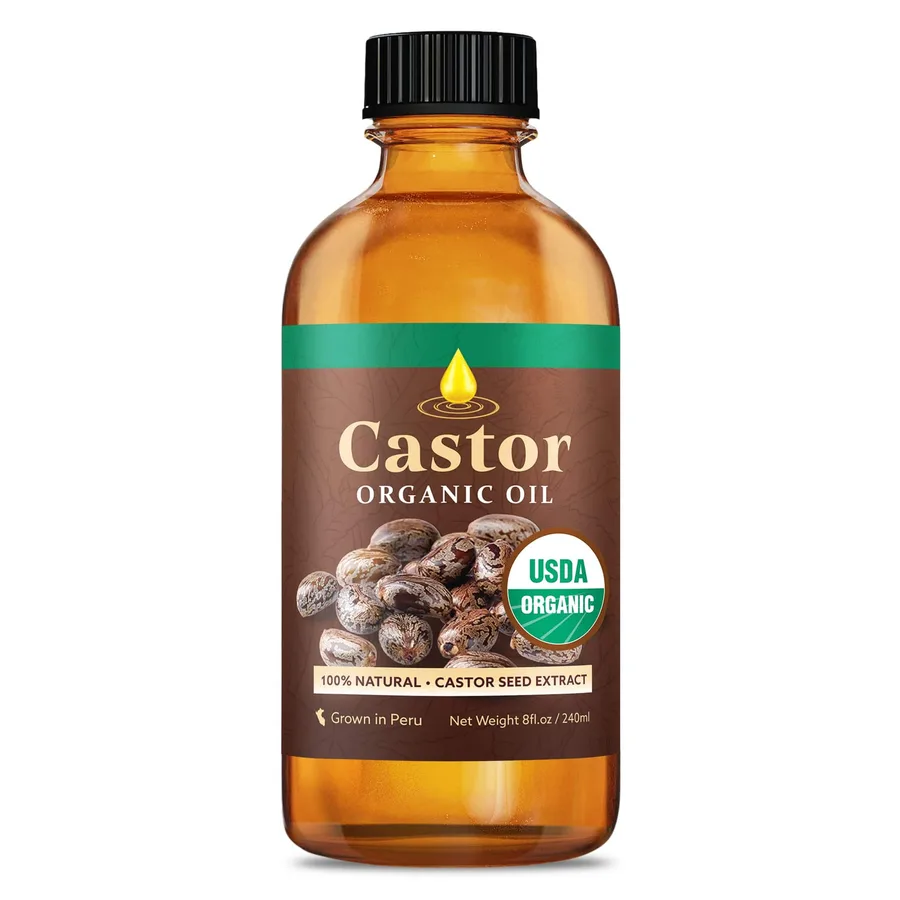
Organic Castor Oil
Cold-pressed, hexane-free castor oil, in sizes from a 0.5 oz sample to bulk drums.
From $13.99
Shop Organic Castor Oil →The molecule in a sentence
Ricinoleic acid is an 18-carbon fatty acid with a double bond partway along its chain and, unusually, a hydroxyl group (an oxygen and a hydrogen, written OH) on carbon 12. Most common fatty acids in everyday skin and hair oils have no such group. That OH is the whole story.
How much of the oil is it? Reviews agree on the idea and differ on the digits. A 2016 review of commercial production says castor oil contains up to 90 percent ricinoleic acid, with smaller amounts of linoleic, oleic, stearic and linolenic acids. A 2021 review puts it at about 75 to 90 percent and lists regional samples anywhere from 75.77 percent to 94.59 percent. So when you see a flat "85 to 95 percent" on a label or a website, read it as the typical neighbourhood, not a fixed number. The exact share moves with the seed and where it was grown.
Why one OH makes oil behave like honey
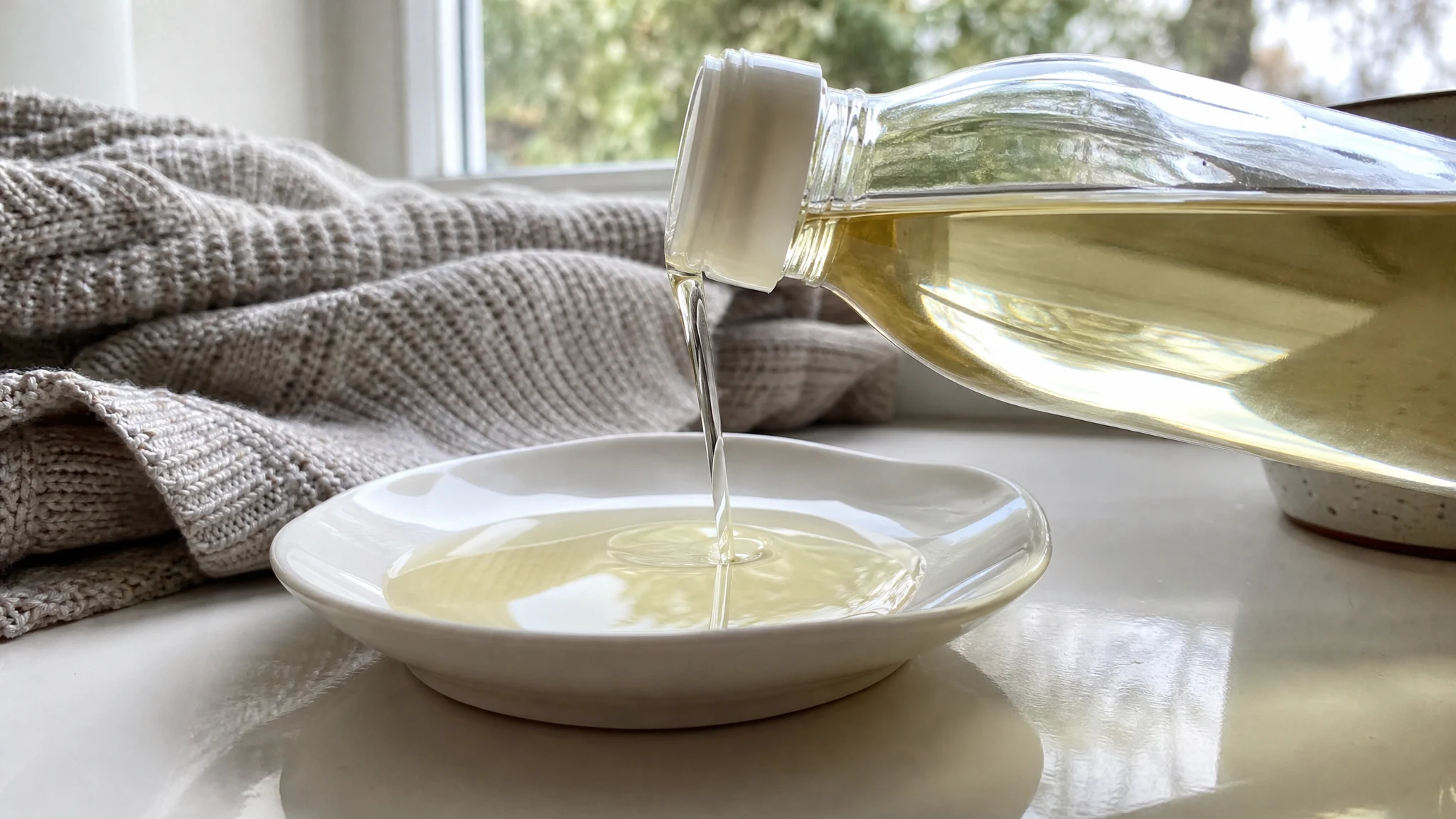
Hydroxyl groups like to hold on to each other and to neighbouring molecules, a bit like tiny hooks. Ordinary oils slide past themselves easily. In castor oil the hooks catch, so the molecules drag, and the result is an oil that pours slowly and spreads slowly. The 2016 review records a viscosity of about 889 cSt for castor oil and notes that high ricinoleic content is what raises it. That chemistry is textbook reasoning rather than something our bottle needs a lab to prove: you can see it the moment you tilt the bottle.
In practice, that means a few useful habits:
- Use less than you think. A few drops warmed between your palms cover more skin or hair than the pour suggests.
- Give it a minute. Thick oil needs a gentle press and a little time to settle.
- Expect a glossy finish. That is the same hooks at work, holding the oil in a rich, shiny layer.
A tidy molecule with a steady temperament
The OH also does something quieter. Both reviews describe the hydroxyl functionality as a source of oxidative stability, because it helps prevent the formation of hydroperoxides, the early products of an oil going off. It is one reason castor oil has a reputation for keeping well, and we cover the practical side in our post on castor oil shelf life.
What it does on skin and hair
The word that fits is emollient. The Cosmetic Ingredient Review, an independent expert panel, lists castor oil and ricinoleic acid among ingredients that work in cosmetics mainly as skin-conditioning agents. In plain terms, a rich layer of oil sits on top, softens how dry skin feels and gives hair a smoother, shinier look. That is the honest scope of it. We are describing what a heavy, well-behaved oil does at the surface, not promising any change beneath it.
If you are curious how people actually use it on the scalp and lengths, we walk through that in castor oil for hair, and the face and body side is in castor oil for skin.
Where this leaves a bottle of castor oil
Because the oil is built around a single fatty acid, castor oil is simple to understand even if the chemistry sounds fancy. Our own is castor oil only, one ingredient, cold-pressed, with nothing else added, so what you see in the bottle is that molecule doing its slow, glossy thing. The basics of the plant and the oil are in what castor oil is.
Next time the oil takes a long moment to leave the neck of the bottle, you can smile and credit carbon 12.
Organic Castor Oil
Cold-pressed, hexane-free organic castor oil, from a 0.5 oz sample to bulk sizes.
From $13.99
Shop Organic Castor Oil →Sources & Further Reading
- Patel VR, Dumancas GG, Kasi Viswanath LC, Maples R, Subong BJJ. Castor Oil: Properties, Uses, and Optimization of Processing Parameters in Commercial Production. Lipid Insights, 2016.
- Yeboah A, Ying S, Lu J, et al. Castor oil (Ricinus communis): a review on the chemical composition and physicochemical properties. Food Science and Technology, 2021.
- Final report on the safety assessment of Ricinus Communis (Castor) Seed Oil, Hydrogenated Castor Oil, Glyceryl Ricinoleate, Glyceryl Ricinoleate SE, Ricinoleic Acid, Potassium Ricinoleate, Sodium Ricinoleate, Zinc Ricinoleate, Cetyl Ricinoleate, Ethyl Ricinoleate, Glycol Ricinoleate, Isopropyl Ricinoleate, Methyl Ricinoleate, and Octyldodecyl Ricinoleate. Cosmetic Ingredient Review expert panel, 2007.